Industrial component designers frequently select high-performance elastomers when demanding hardware applications require extreme thermal resistance and chemical inertness under operating loads. Standard thermoplastic machinery fails to process these specialized compounds because reactive rubber stocks require sustained heat rather than active cooling cycles.
Mastering silicone compression molding demands deep familiarity with viscous material rheology and multi-tonnage hydraulic press controls. Engineering teams must evaluate polymer curing kinetics carefully to prevent structural defects during active commercial production runs.
Raw elastomer preforms behave unpredictably under heavy vertical pressure if volumetric sizing calculations contain minor dimensional errors or density variations. Manufacturing facilities depend on precise charge placement to eliminate internal voids and reduce costly material waste on the factory floor.
Establishing robust operational baselines protects capital investments and ensures uniform physical performance across demanding global distribution channels.
Governing Viscous Elastomer Flow Through Precision Charge Preforming
Solid rubber compounds or liquid blocks require exact volumetric preforming before placement into open mold cavities. Manual cutting or automated dispensing must account for material density shifts to prevent under-filled sections or excessive flash generation.
Tooling engineers calculate initial charge dimensions meticulously to match total cavity volume under maximum clamping tonnage and high temperatures.
Gravity and initial platen positioning dictate how the viscous compound spreads across complex internal core geometries. HordRT implements advanced software simulations to predict material migration pathways before cutting permanent tool steel inserts.
Controlled closing speeds prevent premature cross-linking during the initial compaction phase of high-volume industrial schedules.
Material rheology dictates that raw silicone charges exhibit high resistance to initial shear flow under low hydraulic pressures. Technicians utilize specialized volumetric weighing scales to verify that each preform meets exact mass requirements before molding begins.
Accurate mass distribution ensures uniform density throughout thick structural components without localized weak points or structural voids.
Optimizing Thermal Platens for Complete Cross-Linking Dynamics
Embedded cartridge heaters transfer thermal energy directly through heavy steel tool blocks to initiate rapid chemical vulcanization. Temperature control units maintain steady surface conditions, ensuring the entire elastomer mass cures uniformly without soft pockets.
Precise thermal management secures optimal cross-linking density throughout thick structural walls and intricate sealing lips.
Reactive polymer systems undergo irreversible chemical changes under sustained heat and elevated hydraulic pressure conditions. Molecular cross-linking creates a rigid three-dimensional network that resists environmental creep, aggressive oils, and high temperatures.
Operators monitor thermal monitoring sensors in real time to minimize cycle times while guaranteeing complete material conversion.
Facilities utilizing silicone compression molding benefit significantly from robust thermal uniformity across both upper and lower platen assemblies. Eliminating local thermal gradients prevents internal residual stresses that can distort finished gaskets upon cooling and release.
Maintaining strict temperature parameters safeguards mechanical elasticity over millions of continuous operational cycles.
Thermal transfer efficiency inside large steel molds depends heavily on cartridge heater placement and platen insulation materials. Engineers configure heating zones meticulously to counteract heat loss occurring around outer tool perimeters during high-speed production shifts.
Consistent thermal profiles eliminate incomplete curing issues in deep cavity corners where material thickness increases substantially.
Controlling Flash Extrusion and Parting Line Integrity
Excess compound squeezed past mating surfaces forms thin waste ribbons known as flash, requiring systematic removal prior to final packaging. Uncontrolled flash generation increases post-processing labor and can damage expensive trimming fixtures if waste thickness fluctuates widely.
Tooling designers construct robust structural steel housings to withstand millions of high-tonnage cycles without structural deflection under load.
Master toolmakers execute precision grinding techniques to guarantee absolute flatness across opposing parting lines during high-pressure production runs. HordRT provides specialized engineering support to optimize land areas and venting channels for clean edge extrusion.
Effective flash management reduces scrap rates and accelerates downstream assembly workflows for global manufacturing partners.
Parting line maintenance requires continuous monitoring to prevent abrasive elastomer compounds from eroding sealing surfaces over extended production runs. Tooling surfaces receive specialized hardening treatments to resist wear and maintain tight shut-off boundaries under intense hydraulic clamping forces.
Clear maintenance protocols ensure that flash thickness remains uniform throughout multi-cavity manufacturing programs.
Executing Controlled Demolding and Strict Dimensional Audits
Opening heavy hydraulic presses requires careful extraction mechanics because fully cured elastomer parts exhibit high friction against metal surfaces. Tooling designers incorporate generous draft angles and specialized release coatings into internal cavity walls to facilitate smooth part removal.
Ejector pin layouts distribute stripping forces evenly across flexible surfaces to prevent tearing or permanent distortion.
Final component performance depends heavily on rigorous post-curing quality evaluations and mechanical stress verification under load. Technicians verify that finished rubber seals maintain tight dimensional tolerances and consistent physical elasticity before dispatch.
Silicone compression molding projects demand comprehensive documentation packages to simplify incoming quality control checks for industrial clients.
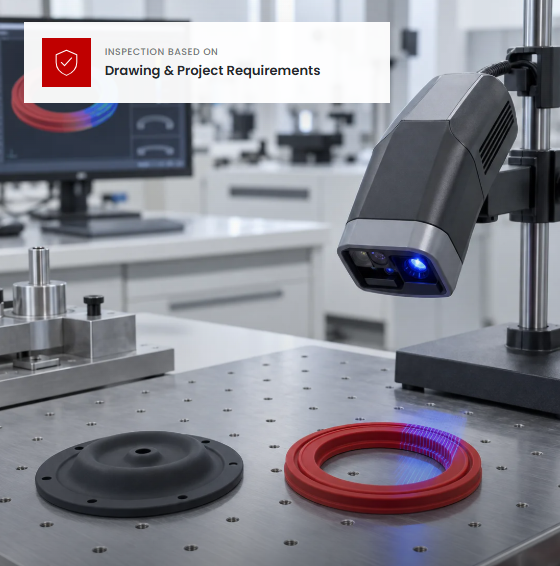
Advanced metrology equipment verifies spatial geometry and wall thickness uniformity across every manufactured production batch. HordRT deploys stringent inspection protocols to ensure complete compliance with automotive and aerospace regulatory standards worldwide.
Rigorous verification standards protect proprietary intellectual property and guarantee absolute operational reliability in the field.
Post-curing thermal ovens frequently complete the vulcanization process by eliminating residual volatile organic compounds from newly molded elastomer components. Manufacturers utilize cleanroom packaging environments to protect sensitive medical and electronics seals from ambient particulate contamination prior to shipment.
Strict environmental controls guarantee that finished elastomeric products meet rigorous cleanliness standards required by modern high-tech industries.