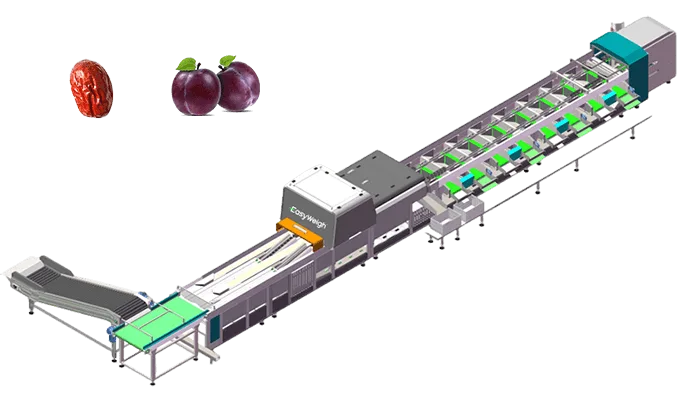
Procuring agricultural separation hardware requires balancing delicate product handling against massive harvest volume requirements. Facility directors frequently struggle to select equipment that protects soft skin surfaces while maintaining rapid processing speeds.
Making an informed procurement choice prevents severe operational bottlenecks and financial loss across intensive seasonal production cycles. Strategic planning eliminates guesswork during capital equipment acquisition while securing sustainable commercial growth for processing plants.
Plant Throughput and Material Vulnerability Constraints
Agricultural produce exhibits extreme natural variation in skin elasticity, moisture content, and geometric shape. Processing soft stone fruit requires vastly different conveyor dynamics than handling dense citrus varieties. Selecting an industrial fruit sorting machine demands precise mapping of peak seasonal volumes against hourly belt velocities to prevent unexpected chokepoints and excessive mechanical wear across drive motors.
Engineers calculate maximum surge capacities to prevent catastrophic upstream backups during peak harvest windows. Underspecified transport drives fail under heavy, continuous moisture loads, leading to frequent line stoppages and costly inventory spoilage.
Matching mechanical limits to actual product physics guarantees long-term operational stability across demanding commercial processing shifts worldwide without unexpected hardware degradation.
Conveyor belt materials must feature non-stick polymer coatings to prevent delicate fruit skins from sustaining friction burns. Transport geometries need smooth transition angles that eliminate abrupt drops between successive conveyor sections. Proper mechanical sizing safeguards against frequent jams and unexpected maintenance interruptions throughout peak operating months.
Optical Versus Gravimetric Data Capture Requirements
Surface blemish detection alone cannot uncover internal bruising or hollow cavities hidden within thick-skinned agricultural yields. Modern processing lines require dual-parameter verification combining high-resolution optical scanning with precise mass quantification.
Integrating Weight Sorting modules bridges critical inspection gaps that single-technology setups leave vulnerable during high-speed production runs across global distribution hubs.
Multi-angle LED lighting and advanced camera arrays isolate color anomalies and microscopic skin cracks reliably. Operators configure multi-tiered reject thresholds to separate sub-standard items without discarding marketable produce. Comprehensive sensory evaluation maximizes commercial yield recovery across every single batch processed.
Spectral imaging sensors penetrate exterior tissue layers to detect internal sugar concentration and early-stage rot formations. High-speed processors cross-reference visual pixel arrays with precise weight metrics before items reach diversion zones. Unified data correlation eliminates human estimation errors entirely.
Minimizing Bruising Through Controlled Rejection Physics
Physical diversion methods must protect delicate cell structures from bruising during high-speed directional changes. Pneumatic air blast nozzles and cushioned swing gates handle fragile produce safely without tearing outer skins or causing internal tissue collapse. Selecting appropriate diversion mechanisms prevents post-harvest spoilage and maintains retail presentation standards globally.
Transport belt stability dictates whether items maintain precise orientation through the entire inspection and rejection zone. Easyweigh incorporates specialized polymer contact surfaces and ultra-smooth transfer chutes designed specifically for agricultural applications to prevent surface scratching. Reliable diversion hardware minimizes maintenance overhead significantly.
Compressed air accuracy ensures that pneumatic jets strike targeted defective fruit without disturbing adjacent marketable items. Maintenance teams inspect valve seals regularly to prevent pressure drops during intensive operational hours. Precision engineering in the ejection zone safeguards overall batch yield percentages.
Enterprise Control Systems and Factory Footprint Realities
Factory floor spatial limitations dictate conveyor lengths and transition angles between adjoining workstation zones. Upgraded hardware must integrate smoothly with existing packaging lines without requiring massive facility architectural overhauls. Power supply capacities and compressed air limits must match active utility footprints.
Supervisory control software dictates how easily floor operators manage daily recipe changes and error diagnostics. Centralized touchscreen dashboards reduce training overhead and minimize operator data entry mistakes significantly. Robust data logging capabilities satisfy rigorous traceability mandates required by modern supply chains.
Easyweigh builds connectivity-ready architectures that interface seamlessly with supervisory enterprise resource planning software networks. Comprehensive diagnostic tools embedded within control interfaces minimize unplanned maintenance downtime and streamline troubleshooting. Technical teams resolve minor anomalies before catastrophic failures interrupt production schedules.
Real-time data transparency builds immense trust between manufacturers and their global supply chain partners during quality audits. Comprehensive digital logging satisfies rigorous regulatory mandates while providing actionable insights for continuous process improvement. Interoperable software systems empower technical teams to resolve minor anomalies before catastrophic failures occur.
Calculating Long-Term Capital Amortization and Vendor Support
Total cost of ownership extends far beyond initial capital expenditure and basic installation fees. Maintenance requirements, spare parts availability, and energy consumption heavily influence long-term financial viability. Procurement teams evaluate vendor support networks and technical training availability before finalizing supply contracts.
Investing in a reliable fruit sorting machine safeguards plant profitability by eliminating human error and product giveaway. Advanced Weight Sorting parameters ensure mass metrics align seamlessly with optical data across various product runs. Strategic equipment choices empower manufacturing facilities to scale operations efficiently.
Easyweigh delivers dependable engineering solutions backed by comprehensive technical assistance throughout the equipment lifecycle. As an experienced manufacturer, Easyweigh supports both standard equipment and custom OEM / ODM services, to adapt sorting solutions for unique production‑line layouts and special product‑grading requirements. Future-proofing production lines safeguards capital investments against premature technological obsolescence in competitive markets. Sustainable commercial growth depends entirely on making informed equipment choices today.
Selecting specialized agricultural automation requires careful balancing of mechanical endurance, precision, and software interoperability. Procuring a high-performance fruit sorting machine transforms raw processing floors into elite operational powerhouses. Integrating Weight Sorting technology guarantees uncompromising product purity and sustainable market competitiveness.