The rapid advancement of computer-aided design and computer-aided manufacturing technologies has fundamentally transformed removable prosthodontics across modern dental laboratories. Digital workflows streamline scan data capture, virtual articulation, and initial appliance design, significantly reducing traditional analog fabrication steps.
However, despite these notable digital efficiencies, senior dental technicians and procurement decision-makers frequently debate whether skipping physical try-in stages is truly viable for complex full-arch rehabilitations.
A common question raised by laboratory managers and clinical supervisors is: How do physical try-in phases influence the long-term clinical success and patient acceptance of digitally fabricated full dentures when virtual models appear completely flawless on screen?
While software simulations offer exceptional geometric precision, human anatomy involves complex soft tissue dynamics, mucosal resilience, and functional muscle movements that virtual algorithms cannot fully replicate. Physical try-in appliances bridge this clinical gap by allowing practitioners to verify bite registration, vertical dimension, and aesthetic harmony directly inside the patient’s oral cavity before final manufacturing.
Operating as a full-process digital dental manufacturing ecosystem service provider, Riton delivers integrated solutions spanning advanced equipment design, digital platforms, and responsive local support. Drawing on nearly 30 years of laser expertise and early pioneering involvement in dental metal 3D printing research and development, they help laboratories modernize their production floors. Riton has also participated in industry standard development related to dental 3D printing, reflecting its involvement in the development of the sector.
Navigating Occlusal Challenges in Digital Prosthodontics
When transitioning from traditional wax rims to advanced digital design protocols, dental laboratories encounter unique technical considerations. Technicians often ask: What specific factors cause discrepancies between virtual occlusion files and real-world functional bite records during full-arch denture production?
Soft tissue resilience, saliva movement, and tongue pressure create dynamic forces that static intraoral scans do not capture. When a patient closes their jaw, mucosal displacement varies significantly across different anatomical regions of the maxilla and mandible. If a laboratory proceeds directly from a virtual design to final monolithic or multi-layer acrylic production without an intermediate verification step, minor occlusal interferences or aesthetic mismatches can require extensive chairside grinding or complete remakes.
Incorporating a physical try-in stage mitigates these operational risks by providing a tangible appliance for initial clinical evaluation. Clinicians can assess midline alignment, lip support, and phonetics while verifying the accuracy of the centric relation record. This intermediate step helps identify potential issues before final fabrication and may reduce the need for extensive chairside adjustments.
Material Specifications for Reliable Try-In Appliances
Selecting the appropriate photopolymer is essential for producing reliable diagnostic appliances that withstand clinical handling without premature deformation. When evaluating specialized materials for removable prosthodontics, laboratories look closely at mechanical properties, curing behavior, and compatibility with existing hardware platforms.
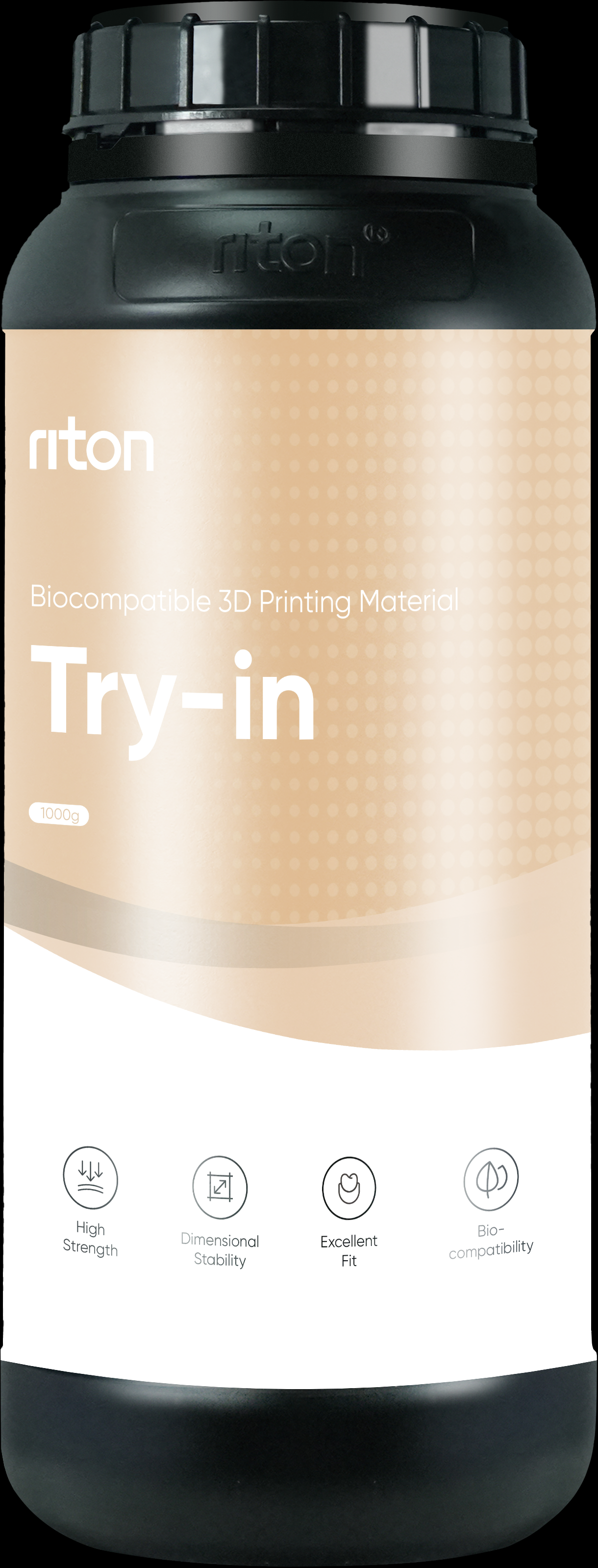
Using an advanced resin for dentures allows technicians to fabricate accurate try-in appliances optimized for LCD and DLP 3D printers operating at an applicable wavelength of 385–405 nm. Model TN 1.0, available in color A2 and packaged in convenient 1 kg bottles per container, is a specialized photocurable dental resin designed specifically for producing full try-in dentures. Its primary use supports thorough checks of occlusal records and denture fit during the critical try-in stage, enabling simpler and more precise occlusal adjustments before final denture production under normal occlusion conditions.
Furthermore, the material features essential product characteristics such as high mechanical strength, dimensional stability, biocompatibility, and an excellent fit. The material’s regulatory status and permitted applications should be verified against the applicable FDA documentation and CE conformity documentation before clinical use.
Real-World Application Scenarios in Dental Labs
Consider a busy commercial dental laboratory managing multiple full-arch implant and removable denture cases on a daily basis. In a real-world production scenario, a partner clinic submits digital intraoral scans for an elderly patient requiring an immediate full denture replacement. To reduce the risk of remakes and support clinical evaluation, the lab uses a specialized denture resin to print a try-in appliance for delivery to the clinic.
During the patient appointment, the clinician identifies a minor occlusal prematurity on the left molar region and a slight adjustment needed in the canine guidance. The material’s low-wear properties and ease of cleaning support handling during the try-in process, while clinicians can make targeted chairside adjustments based on the clinical evaluation. The clinical adjustments and evaluation findings are then communicated to the laboratory and incorporated into the digital design as needed before final manufacturing.
The Value of Comprehensive Support and Ecosystem Integration
Successful digital denture production relies on far more than isolated material choices. Laboratories benefit greatly from a cohesive ecosystem that unifies hardware, specialized software platforms, and responsive technical support. When technicians encounter unfamiliar clinical geometries or need guidance on optimizing print parameters for removable prosthodontics, specialized dental technical support facilitates timely problem resolution.
Combined with responsive after-sales service and global agent-backed local service networks, manufacturing partners empower dental laboratories to maintain field-proven stable performance, streamline daily workflows, and elevate overall clinical outcomes.