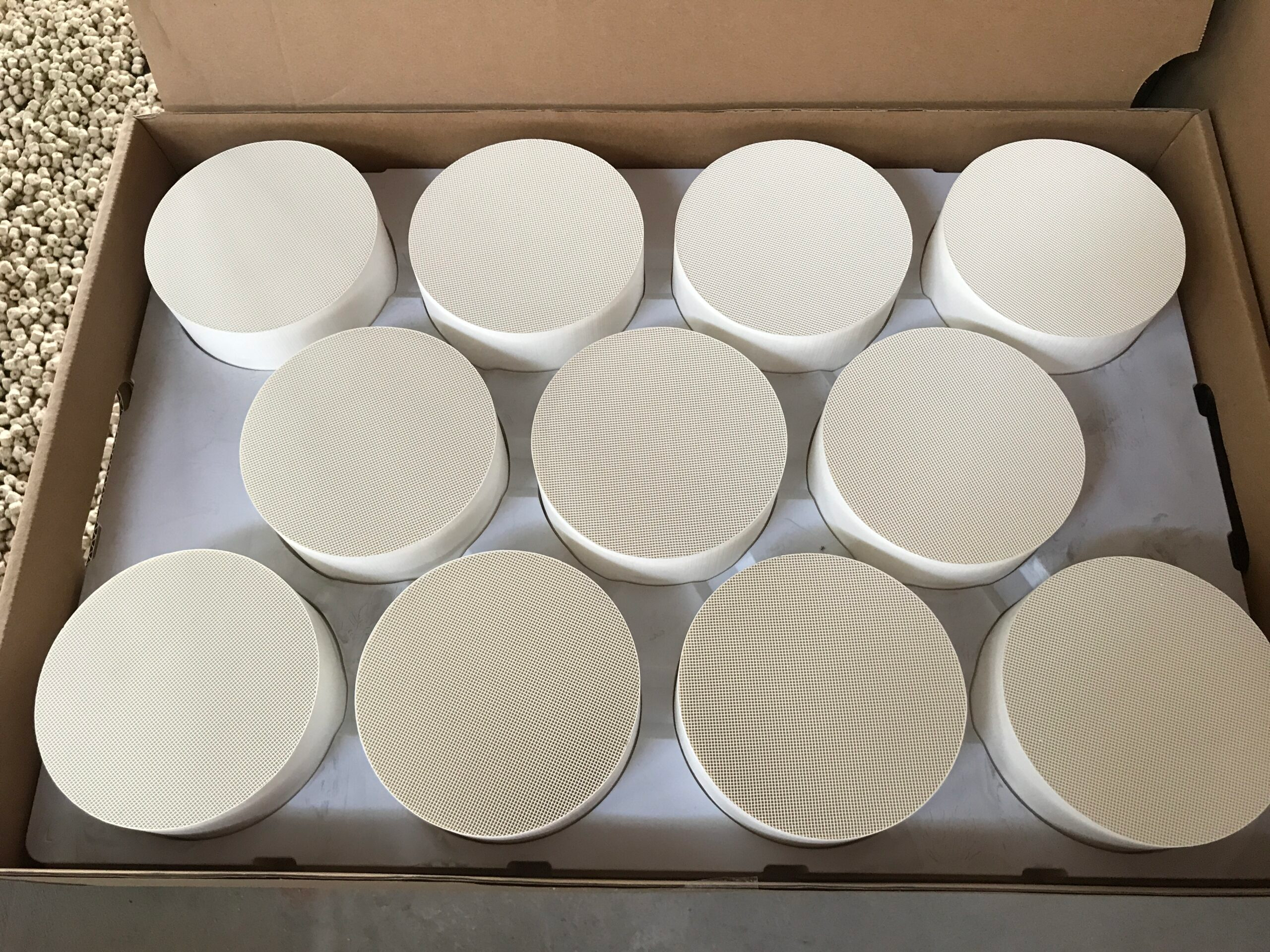
One catalyst support looks like a block pierced by parallel channels; another arrives as many short cylinders intended for a bed. Their shapes reveal different flow strategies. A honeycomb ceramic element gives exhaust a largely open route across coated walls, while a particulate hydrogenation material creates contact through a packed collection of separate bodies.
The support is not merely a container for active material. Its geometry determines how a stream reaches the reaction surface, where pressure is lost, and what mechanical loads the catalyst experiences. Comparing a monolith with a cylindrical particle therefore requires separate questions about flow, contact, and strength before any nominal surface area is considered.
Why Exhaust Uses Parallel Channels
A diesel exhaust stream must pass through its catalyst while the engine operates over a wide flow range. Parallel honeycomb passages divide that stream into many paths with a large coated wall area. Cell density and channel dimensions set part of the tradeoff between exposed surface and resistance. Coating thickness and component length alter the same balance.
The active chemistry on the channels performs the reaction; the ceramic shape distributes gas and carries that material. If the inlet sends most exhaust toward one portion of the face, nominal area elsewhere may contribute less than expected. A sensible test measures conversion and pressure on the installed geometry rather than assuming that the catalog cell count predicts either result.
Many flow channels and low pressure loss characterize the structured honeycomb ceramic diesel catalyst in Hualian Catalyst‘s range, with selectable cell densities up to 600 CPSI. CPSI counts channels per square inch of cross section; it does not state conversion efficiency on its own. The selected density still has to fit exhaust flow, coating, housing, and pressure constraints.
The honeycomb’s thermal and mechanical role matters too. Rapid exhaust changes can impose temperature gradients, and vehicle vibration reaches the mounted block. Cracking, displacement, or a failed seal changes the intended flow path. Support selection consequently joins chemical needs to canning, expansion allowance, and durability testing.
How Particles Serve a Hydrogenation Reactor
An industrial catalyst of hydrogenation has a different path to create contact. Feed and hydrogen move through a bed of discrete catalyst particles instead of through a single exhaust monolith. The exposed exterior and internal pore structure influence access to active sites. Bed depth, particle size, and packing affect residence time and pressure behavior.
Hualian’s hydrogenation product uses alumina carrying nickel-based active material and is supplied as cylindrical particles. Its carrier form belongs to the reactor’s packed-bed arrangement, not to a honeycomb exhaust housing. The active metal and support are chosen for hydrogenation duties; borrowing an automotive monolith’s cell-density figure would not describe this material.
Individual particles experience contact and load from neighboring particles and process flow. Crushing or abrasion can create fines that alter bed void space and fluid distribution. Mechanical strength is therefore a relevant property alongside activity. It addresses whether the original flow and contact pattern can survive loading and operation.
The support’s pores also matter in a way that an external channel count cannot capture. A reactant must reach active nickel sites inside the particle, and products must leave. Surface area is one indicator of potential contact, but pore accessibility and actual process conditions determine its use. Inaccessible pores contribute no reaction contact despite nominal carrier area.
Read HL-1HC Data in Its Own Units
Hualian lists HL-1HC with a surface area of 80–180 m²/g, bulk density of 0.80–0.90 kg/L, and crushing strength of at least 50 N/cm. Each number describes a different aspect of the particulate material. Surface area concerns available internal area; bulk density relates mass to the volume occupied by a collection of particles.
Crushing strength gives a mechanical criterion, but its reported value still needs the stated method and particle form for comparison. It cannot be converted into a honeycomb’s resistance to exhaust vibration. Likewise, a CPSI value for honeycomb ceramic says nothing directly about the active surface inside a porous hydrogenation pellet.
For a catalyst of hydrogenation, those material values have to be read alongside feed, hydrogen supply, pressure, temperature, bed dimensions, and required conversion. For an exhaust catalyst, the corresponding file focuses on flow distribution, channel density, pressure drop, coating, and thermal survival. The two datasets can each be useful without sharing a ranking scale.
The density of a packed collection includes spaces between particles; it is not the solid density of alumina. Likewise, crushing strength describes resistance under a specified loading method, not resistance to every impact encountered during loading. A buyer can use these figures to ask for matched test conditions and tolerances, then compare the delivered material with the approved sample.
Structure influences performance through the way a process fluid meets its active material. A monolith trades channel geometry against exhaust resistance; a catalyst of hydrogenation trades particle contact and strength against reactor flow. Support figures become meaningful only after the reaction and equipment are specified. The right shape is the one whose contact and mechanical behavior fit that process.