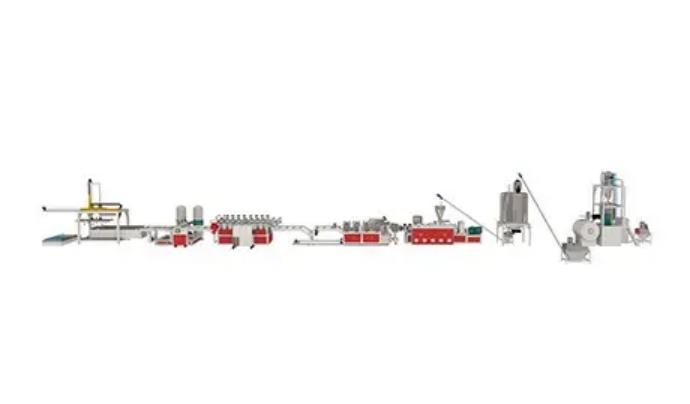
Effective production of Wood Plastic Composite (WPC) flooring requires a strategic balance between mechanical output and labor efficiency. As a multi-layered product featuring a foamed core, WPC demands precise thermal and pressure management. For B2B manufacturers, the primary decision often lies between a semi-automated setup and a fully integrated WPC flooring production line, each offering distinct advantages in terms of scalability and operational control.
The Dynamics of WPC Extrusion Automation
The “semi-automated” approach typically involves manual intervention at specific transition points, such as material feeding or the initial stacking phase. While this provides flexibility for smaller batches or custom profile changes, it introduces variability in cycle times. In contrast, a fully integrated WPC flooring extrusion machine environment utilizes a continuous-flow model.
In an integrated system, the process starts with automated gravimetric dosing of PVC powder and wood flour (typically at a 1:2 or 1:3 ratio). The material moves through a conical twin-screw extruder, where it is plasticized and homogenized. The integration extends to the downstream equipment: the T-die, vacuum calibration, traction, and the cutting unit are all synchronized via a centralized PLC. This synchronization eliminates the bottlenecks and human error risks associated with manual handling, ensuring that the 5mm to 20mm thick boards remain dimensionally stable throughout the cooling phase.
Scalable Solutions by Boyu
For enterprises looking to optimize their industrial footprint, Boyu provides versatile configurations for their WPC flooring production line. Their machinery is engineered to support both high-volume standardized production and specialized custom runs. Their systems often feature intelligent control systems with Siemens or Omron PLCs, allowing for real-time adjustments to extrusion speeds and temperature zones.
Whether a facility requires a capacity of 400kg/h or upwards of 550kg/h, they design their WPC flooring extrusion machine with modularity in mind. Their equipment includes automated plate lifting and stacking systems that further reduce labor strain and increase safety for plant operators. By choosing their solutions, B2B clients benefit from a robust transmission system and an energy-efficient design that lowers the total cost of ownership. Their technical expertise ensures that whether a line is semi-automated for specific architectural profiles or fully integrated for mass-market distribution, it delivers the consistent quality required for high-stakes commercial flooring contracts.